
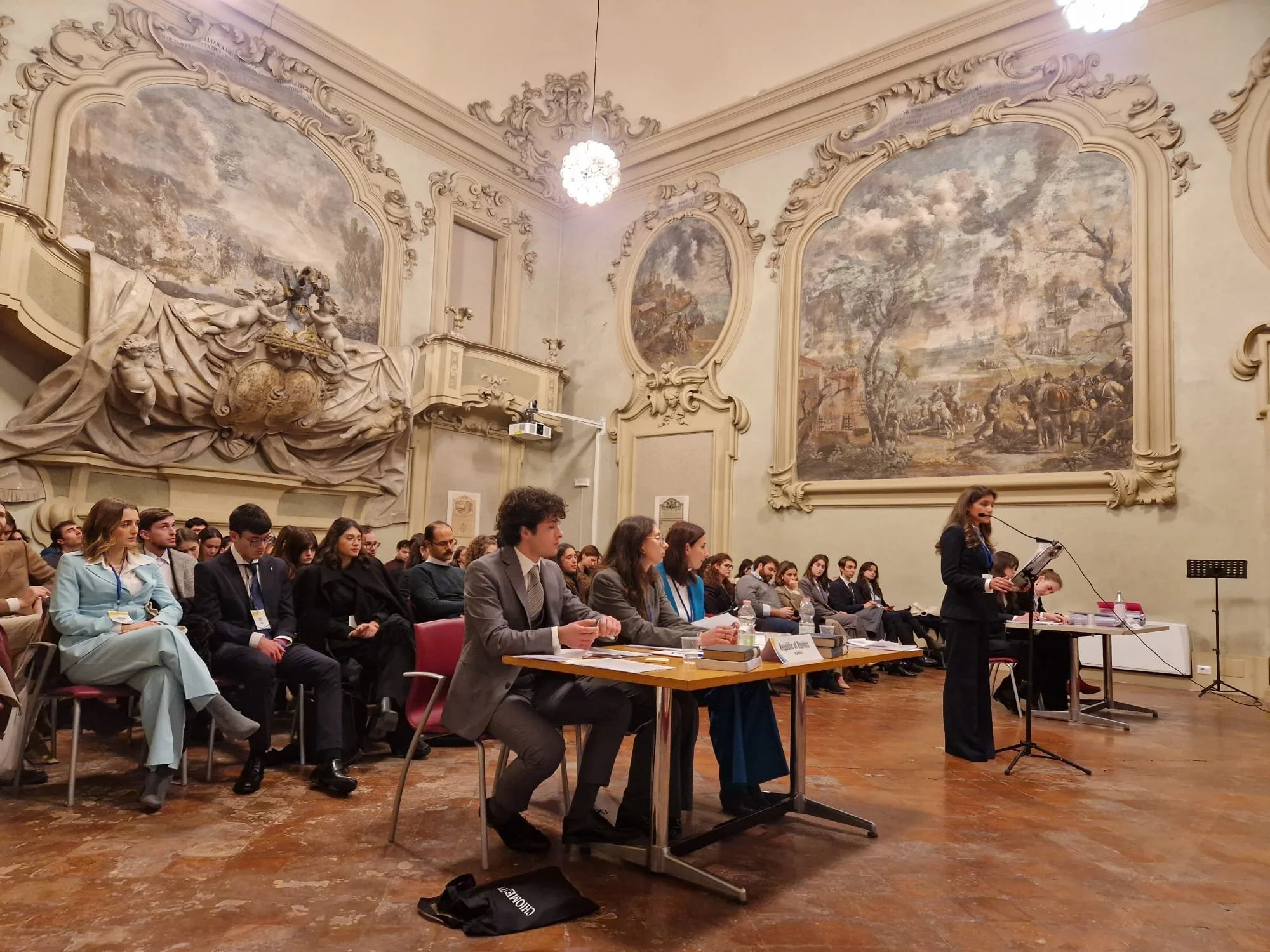
Competing in the Jessup
Team Members and Teams Advisors are at the heart of the Jessup Competition
Each year, the International Law Student Association - which runs the Jessup Competition at international level - publishes the Problem for the competition, as well as the Official Rules and the Competition Schedule
In addition, if you are interested in competing for an Italian university, you can contact the Italian national Administrator at jessup.italianrounds[at]gmail.com
General Information
Eligibility and Participation
-
Any law school, law faculty, or institution with a degree program in international law is eligible to participate in the Competition. Each school may only enter one team to compete, unless the Executive Office determines that extenuating circumstances justify the participation of multiple teams from a single school. Please see the Official Rules, which are released each August, for more detailed information regarding eligibility.
-
Students pursuing a law degree or a degree related to international law at an eligible school may compete on behalf of that school so long as they are enrolled at least part-time and have not engaged in the practice of law after graduating from another law degree program. Some students must also obtain the ILSA Executive Office’s written permission to participate if the Official Rules so require. Please review the Official Rules, which are released each August, for detailed information regarding team member eligibility.
-
Each Jessup Team may have a maximum of five (5) team members. A Jessup Team may choose to have less than five (5) team members, but must have at least two (2) team members to constitute a team. No more than five (5) individuals may contribute to the work product of the team over the course of the competition year. For more information, please see the Official Rules, which are released each August.
-
A team advisor is anyone who is responsible for organizing, advising, or training a Jessup Team, such as coaches and faculty advisors. Anyone may act as a team advisor, including professors, lawyers, graduate students, and former Jessup Competitors. Team advisors are allowed to provide general advice and instruction regarding the basic principles of international law to provided overall guidance, but they are prohibited from doing any work for the team such as drafting specific legal arguments. Jessup Teams are not required to have a team advisor, and as a general rule a team should not have more team advisors than necessary to adequately prepare them for fair competition. For more information, please see the Official Rules, which are released each August.
Competition Format
-
The Philip C. Jessup International Moot Court Competition is an advocacy competition for law students. Teams of law students compete against one another through the presentation of oral and written pleadings to address timely issues of public international law in the context of a hypothetical legal dispute between nations. The Compromis, or Problem, is the springboard for the Jessup Competition. Written by leading scholars of international law, the Problem is a compilation of agreed upon facts about the dispute that is submitted for adjudication to the International Court of Justice (ICJ), the primary judicial organ of the United Nations. After the Problem is released, students begin researching and preparing arguments for both sides of the dispute, drafting and editing written pleadings, called “memorials,” and practicing oral presentations. Each team prepares two written memorials and two 45-minute oral presentations, one for each party to the dispute (the “Applicant” and the “Respondent”). Teams argue alternately as Applicant and Respondent against competing teams before a panel of judges, simulating a proceeding before the International Court of Justice.
-
The Jessup Competition is named after Philip C. Jessup, the United States representative to the International Court of Justice, who was elected by the United Nations to serve a nine-year term in 1961. Judge Jessup had a long and distinguished academic, judicial, and diplomatic career. He practiced law and taught at several American universities until 1961. Jessup was an assistant to Elihu Root during the 1929 Conference of Jurists on the Permanent Court of International Justice. He attended both the Bretton Woods and San Francisco Conferences, and played a key role in the formation of the International Law Commission.
-
The ILSA Executive Office is responsible for the global administration of the Jessup Competition. The ILSA Executive Office appoints Administrators to run Qualifying Rounds in their country. The ILSA Executive Director is the final arbiter in the implementation and interpretation of the Official Rules and Supplements to the Official Rules. The ILSA Executive Director also appoints the National Administrator, a person who is responsible for coordinating the organisation of national selections.
Jessup Italy is the team responsible for the organisation of the Italian National Rounds
-
The you can view the Official Schedule for the Jessup Competition on the ILSA website.
Schools may register for the Jessup Competition up until the Registration Deadline listed in the Official Schedule.
The competition season officially begins in September, when the Jessup Competition Problem (the Compromis) is released. Each team’s written pleadings (memorials) must be submitted to the ILSA Executive Office by the deadline indicated in the Official Schedule (usually the first week of January), or earlier if required by an applicable Rules Supplement.
The Italian National Rounds usually take place in the first half of the month of February.
The team or teams representing each country travel to compete in the White & Case International Rounds in March or April of each year.
-
The official language of the Jessup Competition is English. All memorials and oral pleadings must be in English
-
The Jessup Competition consists of two levels: (1) the Qualifying Rounds, and (2) the White & Case International Rounds.
Qualifying Rounds: If more than one team registers for the Jessup Competition from the same country, Qualifying Round will be held to determine which team(s) will represent the country at the White & Case International Rounds. The Italian national Rounds are the qualifying rounds for Italian universities.
The Italian National Administrator - appointed by the ILSA Executive Director - will be responsible for the organisation of the italian National Rounds.
The Italian National Administrator creates a Rules Supplement to the Jessup Official Rules that will regulate the Italian National Rounds and will be made available each year on the ILSA website.
International Rounds: The highest level of the Jessup Competition is the White & Case International Rounds. The White & Case International Rounds includes Preliminary Rounds, Advanced Rounds, and the World Championship Round.
-
Each team participating in a Qualifying Round will participate in four preliminary oral rounds, pleading twice as Applicant and twice as Respondent. However, if four (4) or fewer teams are participating in a Qualifying Round, the ILSA Executive Office may allow each team to participate in less than four preliminary oral rounds.
If there are any Advanced Rounds and your team advances, it will compete in one (1) additional oral round each time it advances, pleading as either Applicant or Respondent as determined before each Advanced Round.
The Advanced Rounds at the Italian National Rounds may include Quarter-Final, Semi-Final, and Championship Rounds, depending upon the number of teams competing in the Tournament and subject to the Italian National Administrator’s discretion. For more information, please see the Italian Supplement to the Official Rules.
-
Each Qualifying Round may advance at least one team to the White & Case International Rounds of the Competition for every eight teams that participate in its Qualifying Round. Therefore, if twenty teams compete in a Qualifying Round, at least two teams may advance to the White & Case International Rounds. Beyond this minimum threshold, the ILSA Executive Director will determine the exact number of teams that will advance to the White & Case International Rounds and the manner in which they are chosen.